El hockey sobre hielo se originó en Canadá a principios del siglo XIX, basándose en varios deportes similares practicados en Europa, aunque la palabra "hockey" procede del francés antiguo "hocquet", que significa "palo".
El hockey sobre hielo es un deporte de equipo rápido, fluido y emocionante en el que participan dos equipos de seis jugadores (un portero y cinco patinadores) sobre hielo.
Es único entre los deportes de equipo más populares porque se juega sobre una superficie de hielo. Como tal, primero ganó popularidad en los climas más fríos de Canadá y el norte de Estados Unidos, particularmente en el noreste y alrededor de los Grandes Lagos, donde los lagos congelados podían servir como superficies de juego durante el invierno.
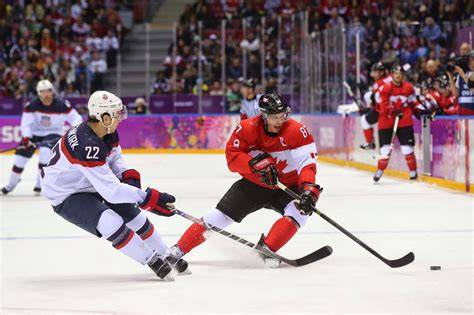
Orígenes y primeras influencias
Hasta mediados de la década de 1980, se aceptaba generalmente que el hockey sobre hielo derivaba del hockey sobre césped inglés y del lacrosse indígena, y que se había difundido por todo Canadá mediante los soldados británicos a mediados del siglo XIX.
Las investigaciones posteriores encontraron menciones de un juego parecido al hockey, jugado a principios del siglo XIX en Nueva Escocia por el pueblo Mi’kmaq (Micmac), que al parecer había estado fuertemente influido por el juego irlandés del hurling; incluía el uso de un “hurley” (palo) y un bloque de madera cuadrado en lugar de una pelota.
Probablemente fue fundamentalmente este juego el que se extendió por Canadá a través de los inmigrantes escoceses e irlandeses y del ejército británico.
Los jugadores adoptaron elementos del hockey sobre césped, como el “bully” (más tarde el face-off) y “shinning” (golpear a un oponente en las espinillas con el palo o jugar con el palo en una “shin” o lado); esto evolucionó hasta convertirse en un juego informal sobre hielo conocido más tarde como shinny o shinty.
El término rink, que se refiere al área designada de juego, se utilizó originalmente en el juego de curling en la Escocia del siglo XVIII.
Primeras reglas y primeros partidos
Los primeros juegos de hockey permitían hasta 30 jugadores por lado sobre el hielo, y las porterías eran dos piedras, cada una congelada en un extremo del hielo.
El primer uso de un puck en lugar de una pelota se registró en Kingston Harbour, Ontario, Canadá, en 1860.
Around 1860, a puck was substituted for a ball.
La versión más modernizada del deporte que se juega hoy fue desarrollada en el este de Canadá, notablemente en Montreal, donde el primer partido de hockey en interior se jugó el 3 de marzo de 1875 entre dos equipos de estudiantes de la Universidad McGill.
El primer partido público de hockey sobre hielo en interior, con reglas tomadas en gran medida del hockey sobre césped, tuvo lugar en Victoria Skating Rink de Montreal en 1875 entre dos equipos de estudiantes de la Universidad McGill.
Desafortunadamente, la reputación de violencia que el juego desarrollaría más tarde fue anunciada en este primer encuentro, donde, según informó The Daily British Whig de Kingston, Ontario, “Shins and heads were battered, benches smashed and the lady spectators fled in confusion.”
El primer equipo organizado, el McGill University Hockey Club, se formó en 1877, codificó las reglas del juego y limitó el número de jugadores por lado a nueve.
El primer equipo reconocido, el McGill University Hockey Club, se formó en 1880, cuando el hockey se convirtió en el deporte nacional canadiense y se extendió por todo el país.
By the late 1800s ice hockey began to rival lacrosse in popularity in Canada.
By the late 1800s ice hockey competed with lacrosse as Canada’s most popular sport.
Organización temprana del hockey canadiense
La primera organización nacional de hockey, la Amateur Hockey Association (AHA) of Canada (que limitaba a siete jugadores por lado), se formó en Montreal en 1885, y la primera liga se formó en Kingston durante el mismo año, con cuatro equipos: el Kingston Hockey Club, Queen’s University, el Kingston Athletics y el Royal Military College.
Queen’s University logró una victoria por 3-1 sobre Athletics en el primer partido de campeonato.
In 1899 the Canadian Amateur Hockey League was formed.
All hockey in Canada at the time was “amateur,” since it was considered “ungentlemanly” to being paid for athletics.
La Stanley Cup y el salto a la fama
En 1893 la atención nacional se centró en el juego cuando el gobernador general canadiense, Frederick Arthur, Lord Stanley of Preston, donó una copa que se entregaría anualmente al mejor equipo canadiense.
The three-foot-high silver cup became known as the Stanley Cup and was first awarded in 1892-93.
La copa de plata de tres pies de altura pasó a ser conocida como la Stanley Cup y fue entregada por primera vez en 1892-93.
The first winner was the Montreal Amateur Athletic Association team, which also captured the Stanley Cup the following season by winning the initial challenge series to determine the Cup holder, which was the Cup-awarding format that Lord Stanley originally intended.
Since 1926 the Stanley Cup has gone to the winner of the National Hockey League playoffs.
The country also provided ice hockey its most prestigious honor, the Stanley Cup, which was first awarded in 1892-93 and has, since 1926, gone to the champion of the National Hockey League (NHL), the sport’s premier level of play.
Expansión a Estados Unidos y profesionalización
The sport migrated south to the United States during the 1890s, and games are known to have taken place there between Johns Hopkins and Yale Universities in 1895.
El deporte emigró al sur de Estados Unidos en la década de 1890, y se sabe que en 1895 se disputaron partidos entre las universidades Johns Hopkins y Yale.
Thus, the first acknowledged professional hockey team in the world was formed in the United States, in 1903, in Houghton, Michigan.
The team, the Portage Lakers, was owned by a dentist named J.L. Gibson, who imported Canadian players.
In 1904 Gibson formed the first acknowledged professional league, the International Pro Hockey League.
Canada accepted professional hockey in 1908 when the Ontario Professional Hockey League was formed.
By that time Canada had become the center of world hockey.
El hockey internacional y la IIHF
In the early 1900s, the Canadian rules were adopted by the Ligue Internationale de Hockey sur Glace, the precursor of the International Ice Hockey Federation (IIHF).
The IIHF's five original members were Great Britain, Bohemia, Switzerland, France, and Belgium.
The first European championship was held at Avants, Switzerland, in 1910, with Great Britain the winner.
From that time the federation broadened its membership, taking applicants from the world over.
Nacimiento de la NHL y consolidación del deporte
The National Hockey Association (NHA), the forerunner of the National Hockey League (NHL), was organized in 1910 and became the strongest hockey association in North America.
Like some of its predecessors, the NHA had its dissenters.
In a move to eject one of the league members, the NHA decided to disband and form a new league.
The result was the creation in 1917 of the National Hockey League (NHL), which became the world’s foremost professional hockey league.
team, the Boston Bruins, joined the NHL.
In 1925 the New York Americans and Pittsburgh Pirates were admitted, followed in 1926 by the New York Rangers, the Chicago Blackhawks, and the Detroit Cougars (later called the Red Wings).
To stock the new teams, the NHL bought out the Patricks’ league in 1926 for $250,000.
Among the players who shifted to Boston was Eddie Shore, known as a “rushing” defenseman, whose style helped change the game.
He was one of the sport’s most ferocious and, many experts say, most skilled players, a forerunner of such future NHL players as Gordie Howe, who played mostly for the Detroit Red Wings.
The Pittsburgh Pirates and the New York Americans eventually dropped out of the league, and, until the expansion of 1967, the NHL was composed of only six teams (long known by the misnomer “the Original Six”): the Rangers, the Bruins, the Blackhawks, the Red Wings, the Toronto Maple Leafs, and the Montreal Canadiens.
Canadá en la élite internacional
Canada captured the first Olympic Games title in 1920 and, concurrently, the first IIHF world championship.
Canada, which also won at the first Olympic Winter Games in 1924, dominated international competition until the emergence of the Soviet team in the early 1960s.
El hockey sobre hielo masculino conformado por seis jugadores por equipo, ha figurado en el programa de todas las ediciones de los Juegos Olímpicos de Invierno desde Chamonix 1924.
Como era de esperar, Canadá dominó los primeros torneos.
Sin embargo, en 1956, y hasta su disolución, la Unión Soviética tomó el relevo y se convirtió en el equipo número uno.
La historia completa del hockey olímpico
Innovaciones clave y cambios de reglas
Rising interest in the game created problems, however, for there were few artificial-ice rinks.
The PCHA became involved in a money and player war with the NHA.
Although the NHA ultimately emerged as the stronger league, it was the PCHA that introduced many of the changes that improved the game.
The only radical rule change adopted by the NHA was to reduce the number of players on a side to six, and that move was made to save money.
The western league retained seven-man hockey, but it allowed the goalie to leap or dive to stop the puck.
Under the previous rules, a goalie had to remain stationary when making a save.
The western league also changed the offside rule.
Under the old rules, a player had been deemed offside if he was ahead of the puck carrier when he received a pass.
The PCHA divided the ice into three zones by painting two blue lines across the surface and allowed forward passing in the center zone between the blue lines.
This opened up the game and made it more exciting.
Another innovation in the western league was the idea of the assist.
Previously, only the goal scorer had been credited with a point.
In the PCHA the player or players who set up his goal were credited with an assist.
The first numbered uniforms also appeared in the league.
By the opening of the 20th century, sticks were being manufactured, shin pads were worn, the goaltender began to wear a chest protector (borrowed from baseball), and arenas (still with natural ice and no heat for spectators) were being constructed throughout eastern Canada.
La NHL como liga dominante
The regular season consists of 82 games and determines the 16 teams that will qualify for the playoffs.
The playoff winner is awarded the Stanley Cup.
NHL individual awards include the Vezina Trophy, for the goalie voted best at his position by NHL managers; the William M. Jennings Trophy, for the goalie or goalies with the team permitting the fewest goals; the Calder Memorial Trophy, for the rookie of the year; the Hart Memorial Trophy, for the most valuable player; the James Norris Memorial Trophy, for the outstanding defenseman; the Art Ross Trophy, for the top point scorer; the Lady Byng Memorial Trophy, for the player best combining clean play with a high degree of skill; the Conn Smythe Trophy, for the playoffs’ outstanding performer; the Frank J.
El hockey femenino y la expansión moderna
Though at times considered a male sport, hockey has been played by women for over 100 years.
The first all-female game was in Barrie, Ontario, Canada, in 1892, and the first world championship was held in 1990.
Recognizing the growing popularity of the sport, the International Olympic Committee added women’s ice hockey to its 1998 schedule at Nagano, where the sport made its first Winter Games appearance.
Several women’s leagues were formed in North America in the early 21st century, and the Professional Women’s Hockey League was founded in 2023 in an attempt to unify the sport.
Its six teams played the league’s inaugural season in 2024.
La dimensión global del hockey
La historia de la National Hockey League es una de las más convincentes de los principales deportes profesionales.
Desde 1938 cuando los Montreal Canadiens y Detroit Red Wings, se convirtieron en los primeros dos equipos de la NHL en jugar en suelo europeo, con tres partidos en Francia y otros seis en Inglaterra, la liga ha destacado por impulsar el juego, más allá de las fronteras de los Estados Unidos y Canadá.
A lo largo de los años, la concepción del hockey como un "deporte americano", se ha desvanecido pues si bien, la sede y principales figuras en la historia de la NHL se ubican en América del Norte, el surgimiento de íconos europeos, así como la incorporación de mercados de Asia, no sólo han trasladado la popularidad del deporte a nuevos territorios, sino a la vez, se ha logrado impulsar el desarrollo de nuevas figuras con una base cultural diferente y por ende, enriquecedora.
| Hito | Dato |
|---|---|
| Primer partido indoor | 3 de marzo de 1875 |
| Primer puck registrado | 1860 |
| Stanley Cup | 1892-93 |
| NHL | 1917 |
| Oro olímpico de Canadá | 1920 |