Rayo Vallecano de Madrid, S.A.D. es un club profesional de fútbol con sede en el distrito madrileño de Puente de Vallecas, España. Compite en La Liga, la máxima categoría del fútbol español, y fue fundado el 29 de mayo de 1924.
El club es conocido como Rayo, Los Franjirrojos, Rayito, Orgullo de la clase obrera y El Matagigantes. Su identidad está estrechamente vinculada con Vallecas, un barrio tradicionalmente obrero de Madrid, y con una cultura sociodeportiva caracterizada por la fuerte relación entre el equipo, la comunidad local y sus seguidores.
Datos principales
| Dato | Información |
|---|---|
| Nombre completo | Rayo Vallecano de Madrid, S.A.D. |
| Nombre corto | RAY |
| Apodos | Rayo; Los Franjirrojos; Rayito; Orgullo de la clase obrera; El Matagigantes |
| Fundación | 29 May 1924; 102 years ago as Agrupación Deportiva El Rayo |
| Ciudad | Madrid |
| País | España |
| Estadio | Campo de Fútbol de Vallecas |
| Capacidad | 15,000 |
| Competición | La Liga |
| Temporada 2025-26 | La Liga, 8th of 20 |
| Sitio web | rayovallecano.es |
Fundación y primeros años
Rayo Vallecano was founded on 29 May 1924 in the hometown of Prudencia Priego, wife of the club's first president Julián Huerta. Agrupación Deportiva El Rayo (29 May 1924 - 13 November 1947).
Agrupación Deportiva Rayo Vallecano (13 November 1947 - 1995). Rayo Vallecano de Madrid (1995-present).
Greatly inspired by Argentina's River Plate, in 1949, after an agreement with Atlético Madrid, a red diagonal stripe was added to the team's kit, and the club reached Tercera División for the first time in its history.[2]
N.B. Affiliate of Atlético Madrid in 1949-50.
Nombre, escudo e identidad deportiva
Rayo Vallecano de Madrid, S.A.D. (Spanish pronunciation: [ˈraʝo βaʎeˈkano ðe maˈðɾið]),[a] often abbreviated to Rayo (Spanish for "lightning bolt"), is a professional football club based in the Puente de Vallecas district of Madrid, Spain.
El nombre Rayo significa «relámpago» o «rayo» en español y se refleja en la identidad visual y deportiva del club. La franja diagonal roja incorporada en 1949 se convirtió en uno de los elementos más reconocibles de su equipación.
Estadio y localización
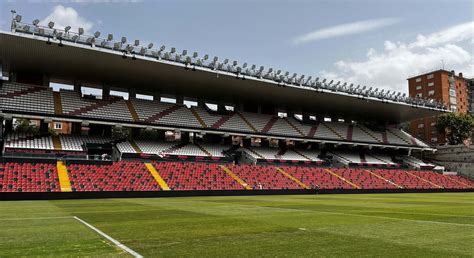
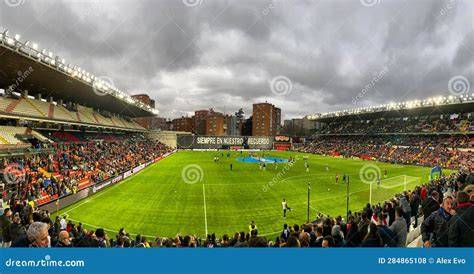
Its home matches have been played at the 14,708-capacity Campo de Fútbol de Vallecas stadium since 1976.[1] Rayo Vallecano home stadium Vallecas.
El estadio aparece también identificado como Campo de Fútbol de Vallecas, con una capacidad indicada de 15,000 espectadores. La información del club sitúa el estadio en Madrid, mientras que otra referencia identifica el estadio como Estadio Ontime Butarque, Leganés, con una capacidad de 14,500.
Coordinates: 40°23′30.6″N 3°39′30.9″W / 40.391833°N 3.658583°W.
Trayectoria histórica
One of the perennial yo-yo clubs of Spanish football, and always in the shadow of the two biggest clubs in the city (Real Madrid and Atlético Madrid), Rayo Vallecano spent many years during the 1980s and 1990s moving back and forth between La Liga and Segunda División.
Durante su historia, Rayo ha disputado 22 temporadas en la máxima categoría y ha participado en dos competiciones europeas: la Copa de la UEFA en la temporada 2000-01 y la UEFA Conference League en la temporada 2025-26.
Décadas de 1980 y 1990
The 1983-84 season was the worst during the 1980s. The club finished in the last position in Segunda División and was relegated to Segunda División B.[3]
Due to a tragedy Rayo Vallecano turned out to be Laurie Cunningham's last club; he was killed in a car crash just outside Madrid in 1989, after a sole season. He had recently won an F.A. Cup winners medal with Wimbledon F.C. in England the previous year and had also represented neighbours Real Madrid for four years.
They appeared to have consolidated their top flight status after gaining promotion in 1999, and the team's most successful season came in 2000-01 when they reached the quarter-finals of the UEFA Cup, going out only to eventual runners-up Alavés;[4] Rayo finished ninth in the previous campaign, but entered the competition via the fair play draw.[5]
2003-2011: Segunda División y categorías inferiores
However, the club shortly thereafter fell on hard times, enduring successive relegations in 2003 and 2004.
For 2005-06 manager Míchel, a Real Madrid legend in the 1980s and '90s, was hired.[6] Rayo finished the 2006-07 season in second place in Segunda División B, winning the promotion play-off semifinal but losing in the final to Eibar (1-2 aggregate).[7]
The following campaign, the team returned to division two after a four-year absence after a victorious run in the playoffs, disposing of Benidorm in the semi-final and Zamora in the last game 2-1 on aggregate.[8]
In its first seasons back in the second tier of Spanish football, Rayo finished comfortably, often either in or just outside the promotion places.
In 2010-11, the team ranked in second position and returned to the top flight after an eight-year absence, only trailing champions Real Betis in spite of very serious economic problems.[9][10][11]
Regreso a La Liga y descenso de 2016
In May 2016, Rayo Vallecano were relegated to the Segunda División, finishing 18th in the 2015-16 La Liga season. This ended their five-year streak in La Liga, their longest ever stay in the top-flight.[15]
Their first season back in the second division was a poor one, with both problems on the field and off, and they finished in 12th position.
Rayo went through three managers in the 2016-17 Segunda División season before finally settling on club legend Míchel.[16] He revived the club from the relegation places to 12th, almost making the playoffs.
Ascenso de 2018
At the start of the 2017-18 Segunda División season, the club appointed their recently retired goalkeeper David Cobeño as the sporting director of the club.[17]
They secured their promotion with a 1-0 over CD Lugo with one game remaining.[18] That season the club won Segunda División with 76 points in 42 games.[19]
Segunda División (2nd tier): Winners (1): 2017-18. Runners-up (4): 1988-89, 1991-92, 1994-95, 2010-11.
Descenso de 2019 y ascenso de 2021
On 20 March 2019, the club appointed Paco Jémez as head coach,[20] and on 4 May, Rayo was relegated back to the Segunda División after losing 4-1 to Levante UD, eventually finishing last.[21][22]
In August 2020, the club appointed Andoni Iraola as head coach.[23] They finished sixth and won promotion in the playoffs against Girona FC; despite losing the first leg at home 1-2, the team came back to win the second leg 2-0 away to claim a place in La Liga for 2021-22.[24]
La Copa del Rey y la etapa reciente
In February 2022, Iraola's side defeated RCD Mallorca to make the semi-finals of the Copa del Rey; it was the second time in club history and first since 1982.[25]
The club finished 12th in La Liga. This was a big achievement as they were by far the league's smallest team, and most had predicted that they would be relegated.[26]
They once again qualified for European football after 24 years, entering into the UEFA Conference League play-offs by finishing 8th in 2024-25 season.
They went on to make their debut appearances in a major UEFA competition group or league phase by reaching the 2025-26 UEFA Conference League league phase.
They finished the league phase in fifth place (out of 36) qualifying directly to the round of 16, and subsequently qualified for their first-ever European semi-final and final.
On 27 May 2026 in their first ever European final, they lost 1-0 to Crystal Palace.[27]
la historia del Rayo Vallecano⚡|| el equipo de los obreros 🔴
Competiciones europeas
Rayo has spent 22 seasons in the top-flight, and has played in two European competitions, the UEFA Cup in the 2000-01 season and the 2025-26 UEFA Conference League.
The team's most successful season came in 2000-01 when they reached the quarter-finals of the UEFA Cup, going out only to eventual runners-up Alavés.[4]
En la UEFA Conference League 2025-26, el club alcanzó por primera vez la fase de liga de una competición europea importante, terminó quinto entre 36 equipos y avanzó directamente a los octavos de final.
UEFA Conference League: Runners-up (1): 2025-26.
Cultura del club y aficionados
Rayo Vallecano is a football club based in the Vallecas neighbourhood of Madrid, traditionally considered a working-class area with a strong leftist identity.
Vallecas was a Republican stronghold during the Spanish Civil War and grew significantly under the Franco regime as it received migrants from other parts of Spain, many of whom had experienced economic hardship or political repression.[28]
The club is closely associated with the local community, and both the neighbourhood and the club maintain a distinct identity, often emphasised through the alternative spelling "Vallekas".[29][30]
Consequently, Rayo Vallecano’s supporters, particularly the ultras group Bukaneros, are often left-wing, anti-fascist, and politically active.[31]
Los Bukaneros
In the stands, they regularly display banners, flags, and visual displays expressing opposition to racism, fascism, homophobia, and the commercialisation of football, while also supporting women's rights, workers' rights, and international solidarity, including pro-Palestine messaging.[28]
Chants often carry political content, and fans have a tradition of imaginative collective protest, such as mocking league decisions on match scheduling or highlighting perceived exploitation of supporters.
Republican flags, Che Guevara images, and the Spanish Civil War slogan "¡No pasarán!" are commonly displayed at games.[32]
In 2014 the club and fan base aided Carmen Martinez Ayudo, an 85-year-old local woman, after she was evicted from her home, and flew banners reading "The evictions of a sick state, the solidarity of a working-class neighbourhood" displayed at the following match.[32][31]
In late March 2012, the Rayo squad took one day off training to join demonstrations supporting the 2011-12 Spanish protests.[33]
Conflictos y activismo
The fanbase actively enforces its political views; In February 2017, Ukrainian player Roman Zozulya left the club after one training session due to chants by Rayo fans accusing him of far-right affiliations; Zozulya denied any such associations and returned to his parent club Real Betis.[34][35]
Following the training ground incident, Rayo Vallecano fans continued to target Roman Zozulya in December 2019 during a Segunda División match against Albacete Balompié, whom Zozulya eventually moved to.
The match was abandoned at half-time after home supporters chanted "Zozulya, you are a Nazi!". The league, both clubs, and the referee agreed to suspend the game to protect players and uphold competition values.
Rayo's president, Raúl Martín Presa, publicly condemned the chants and met with Zozulya to express support and respect.[36]
Supporters of the club have come into conflict with clubs of opposing ideologies: Rayo Vallecano fans have violently clashed with right-wing nationalist supporters, including Polish clubs Jagiellonia Białystok and Lech Poznań, during encounters that both occurred in 2025.[37][38]
In September 2025, members of the Bukaneros were reported to have acted as part of a security detail escorting Podemos leaders Ione Belarra and Irene Montero during pro-Palestinian protests at the end of a stage of Vuelta a España in Madrid.
The group was coordinated by lawyer Erlantz Ibarrondo, a long-standing figure on the Spanish radical left, and included other Bukaneros supporters.
The protests involved clashes with police, with 22 officers injured and two people arrested, and led to the suspension of the stage finish and award ceremony in Plaza de Cibeles.
The Bukaneros and legal team were present to prevent the political leaders from being crowded or attacked by other demonstrators.[39]
Relación con la directiva
The fanbase is independent and frequently opposes the club's management.
Rayo Vallecano's fans do not have a good relationship with the current owner Raúl Martín Presa and regularly chant for him to leave.[40][41]
Owner: Raúl Martín Presa. President: Raúl Martín Presa. Head coach: Beñat San José.
Equipaciones y causas sociales
Kits featuring rainbow symbolism used by Rayo Vallecano in 2015/2016 to represent various causes.
In July 2015, Rayo Vallecano unveiled a new kit featuring a rainbow, with each colour representing a different social cause: red for those fighting cancer, orange for disability integration, yellow for hope, green for environmental protection, blue against child abuse, indigo against domestic abuse, and violet for LGBTQ+ equality.
Part of the proceeds from kit sales were pledged to these causes.
While broadly praised by the public, the Bukaneros criticised it as cynical and superficial move by management and accused management of not genuinely supporting those causes.[42]
Himnos y canciones
Although most people recognise the supporting songs by ska-punk band Ska-P (Rayo Vallecano and Como un rayo), Rayo Vallecano has an official anthem which played at their home stadium before matches.
The club is also known for chanting the song "La Vida Pirata" (English: "The Pirate Life"), a song about pirates, which the Bukaneros are named after.
Palmarés
| Competición | Logro |
|---|---|
| Segunda División | Winners (1): 2017-18 |
| Segunda División | Runners-up (4): 1988-89, 1991-92, 1994-95, 2010-11 |
| Tercera División / Segunda División B | Winners (4): 1955-56, 1964-65, 1984-85, 2007-08 |
| UEFA Conference League | Runners-up (1): 2025-26 |
| Regional Workers Federation of Soccer | 1931-32 |
| First Regional Division | 1948-49 |
| Second Regional Division | 1940-41 |
| Copa de Castilla | 1952-53, 1967-68, 1970-71, 1972-73, 1981-82 |
| Madrid Cup | 1952-53, 1966-67 |
| Copa Ramón Triana | 1971-72, 1973-74 |
Rendimiento histórico por temporadas
| Temporada | Nivel | División | Posición | Copa del Rey |
|---|---|---|---|---|
| 1940-41 | 5 | 2ª Reg. | 2nd | |
| 1941-42 | 4 | 1ª Reg. | 4th | |
| 1942-43 | 4 | 1ª Reg. | 3rd | |
| 1943-44 | 4 | 1ª Reg. | 7th | |
| 1944-45 | 5 | 2ª Reg. | 2nd | |
| 1945-46 | 4 | 1ª Reg. | 5th | |
| 1946-47 | 4 | 1ª Reg. | 10th | |
| 1947-48 | 4 | 1ª Reg. | 6th | |
| 1948-49 | 4 | 1ª Reg. | 3rd | |
| 1949-50 | 3 | 3ª | 14th | |
| 1950-51 | 3 | 3ª | 13th | |
| 1951-52 | 3 | 3ª | 9th | |
| 1952-53 | 3 | 3ª | 7th | |
| 1953-54 | 3 | 3ª | 17th | |
| 1954-55 | 3 | 3ª | 2nd | |
| 1955-56 | 3 | 3ª | 1st | |
| 1956-57 | 2 | 2ª | 12th | |
| 1957-58 | 2 | 2ª | 6th | |
| 1958-59 | 2 | 2ª | 14th | First round |
| 1959-60 | 2 | 2ª | 5th | First round |
| 1960-61 | 2 | 2ª | 16th | First round |
| 1961-62 | 3 | 3ª | 3rd | |
| 1962-63 | 3 | 3ª | 2nd | |
| 1963-64 | 3 | 3ª | 3rd | |
| 1964-65 | 3 | 3ª | 1st | |
| 1965-66 | 2 | 2ª | 9th | First round |
| 1966-67 | 2 | 2ª | 6th | First round |
| 1967-68 | 2 | 2ª | 4th | Round of 32 |
| 1968-69 | 2 | 2ª | 9th | |
| 1969-70 | 2 | 2ª | 6th | Round of 32 |
| 1970-71 | 2 | 2ª | 5th | Round of 32 |
| 1971-72 | 2 | 2ª | 8th | Fourth round |
| 1972-73 | 2 | 2ª | 11th | Third round |
| 1973-74 | 2 | 2ª | 14th | Round of 16 |
| 1974-75 | 2 | 2ª | 8th | Fourth round |
| 1975-76 | 2 | 2ª | 9th | Second round |
| 1976-77 | 2 | 2ª | 3rd | Third round |
| 1977-78 | 1 | 1ª | 10th | Third round |
| 1978-79 | 1 | 1ª | 15th | Round of 16 |
| 1979-80 | 1 | 1ª | 16th | Quarter-finals |
| 1980-81 | 2 | 2ª | 5th | Quarter-finals |
| 1981-82 | 2 | 2ª | 7th | Semi-finals |
| 1982-83 | 2 | 2ª | 9th | Round of 16 |
| 1983-84 | 2 | 2ª | 20th | Third round |
| 1984-85 | 3 | 2ª B | 1st | Third round |
| 1985-86 | 2 | 2ª | 15th | Fourth round |
| 1986-87 | 2 | 2ª | 5th | First round |
| 1987-88 | 2 | 2ª | 5th | Round of 32 |
Plantilla
| N.º | Jugador | Posición | Edad | Pun |
|---|---|---|---|---|
| 24 | Florian Lejeune | D(C) | 35 | 88 |
| 20 | Iván Balliu | D,MD(DI) | 34 | 86 |
| 0 | Raúl de Tomás | A(C) | 31 | 84 |
| 18 | Álvaro García | MO,A(DI) | 33 | 87 |
| 8 | Unai López | M,MO(C) | 30 | 87 |
| 7 | Augusto Batalla | PO | 30 | 87 |
| 5 | Isi Palazón | MO,A(DIC) | 31 | 88 |
| 4 | Luiz Felipe | D(C) | 29 | 87 |
| 19 | Pedro Díaz | M,MO(C) | 28 | 87 |
| 23 | Jorge de Frutos | MO(DI),A(DIC) | 29 | 88 |
| 10 | Óscar Valentín | MD,M(C) | 32 | 87 |
| 14 | Sergio Camello | A(C) | 25 | 86 |
| 6 | Giorgi Tsitaishvili | D,MD(I),M,MO(DI) | 25 | 84 |
| 11 | Pathé Ciss | MD,M(C) | 32 | 87 |
| 9 | Randy Nteka | MO,A(C) | 28 | 85 |
| 1 | Alexandre Alemão | MO(DI),A(DIC) | 28 | 86 |
| 2 | Dani Cárdenas | PO | 29 | 83 |
| 33 | Andrei Rațiu | D,MD,M,MO(D) | 28 | 89 |
| 21 | Jozhua Vertrouwd | D(IC),MD,M(I) | 22 | 80 |
| 22 | Fran Pérez | MO,A(DI) | 24 | 86 |
| 37 | Pelayo Fernández | D(C) | 23 | 77 |
| 36 | Rayane Belaid | M(C),MO(DIC) | 21 | 78 |
| 28 | Gnangoro Bouare | MD,M(C) | 22 | 73 |
| 25 | Samu Becerra | M(C) | 20 | 76 |
| Emil Audero | PO | 29 | 85 | |
| Marash Kumbulla | D(C) | 26 | 86 | |
| Adrià Pedrosa | D,MD,M(I) | 28 | 86 | |
| Mujaid Sadick | D(C) | 26 | 85 |
Cesiones y personal
Rayo Vallecano Cedidos.
Owner: Raúl Martín Presa. President: Raúl Martín Presa. Head coach: Beñat San José.
Rayo Vallecano Personal: Dueño: No existen miembros en plantilla de este tipo. Presidente: No existen miembros en plantilla de este tipo. Entrenador: No existen miembros en plantilla de este tipo. Fisio: No existen miembros en plantilla de este tipo. Ojeador: No existen miembros en plantilla de este tipo.
Formación del equipo
Formación del equipo 4-2-3-1.
La estructura 4-2-3-1 combina una línea de cuatro defensas, dos centrocampistas de apoyo, tres futbolistas por detrás del delantero y un atacante central.
Rivales y posición histórica
Rayo Vallecano Rivales.
By historical performance, Rayo is the third best club in Community of Madrid, after Real Madrid and Atlético Madrid.
| Posición | Club | Puntos |
|---|---|---|
| 1 º | FC Barcelona | 18 ptos. |
| 2 º | Real Madrid | 15 ptos. |
| 3 º | Real Betis | 15 ptos. |
| 4 º | Atlético de Madrid | 13 ptos. |
| 5 º | Sevilla FC | 13 ptos. |
| 6 º | Deportivo Alavés | 10 ptos. |
| 7 º | RC Deportivo | 9 ptos. |
| 8 º | RCD Espanyol | 7 ptos. |
| 9 º | Athletic Club | 7 ptos. |
| 10 º | Real Racing Club de Santander | 7 ptos. |
| 11 º | Rayo Vallecano | 7 ptos. |
| 12 º | Real Sociedad | 7 ptos. |
| 13 º | CA Osasuna | 7 ptos. |
| 14 º | Villarreal CF | 5 ptos. |
| 15 º | Levante UD | 5 ptos. |
| 16 º | Getafe CF | 5 ptos. |
| 17 º | RC Celta | 4 ptos. |
| 18 º | Valencia CF | 4 ptos. |
| 19 º | Málaga CF | 3 ptos. |
| 20 º | Elche CF | 2 ptos. |
Calendario de competición
- Amistoso
- Amistoso
- Amistoso
- Amistoso
- Amistoso
- Amistoso
- Amistoso
- Jornada 2
- Jornada 1
- Jornada 3
- Jornada 4
- Jornada 5
- Jornada 7
- Amistoso
- Jornada 8
- Jornada 9
- Jornada 6
- Jornada 10
- Jornada 11
- Jornada 12
- Jornada 13
- Jornada 14
- Jornada 15
- Jornada 16
- Jornada 17
- Jornada 18
- Jornada 19
- Jornada 20
- Jornada 21
- Jornada 22
- Jornada 23
- Jornada 24
- Jornada 25
- Jornada 26
- Jornada 27
- Jornada 28
- Jornada 29
- Jornada 30
- Jornada 31
- Jornada 32
- Jornada 33
- Jornada 34
- Jornada 35
- Jornada 36
- Jornada 37
- Jornada 38
En agosto de 2015, Rayo Vallecano purchased the majority of Oklahoma City FC, a NASL expansion franchise which had yet to officially play a game renaming the club to Rayo OKC, despite the stadium increasingly needing work.
It was the first ever entry of a Spanish club into the American sports market and mirrored a 2013 sponsorship agreement with Qbao in terms of expanding the club's profile overseas.[13][14]
Rayo OKC folded after a year due to Rayo Vallecano's relegation from La Liga and a dispute between the co-owners led to less finance for the U.S. side.